How Whitman made his books
Walt Whitman’s role in the physical production of Leaves of Grass, from 1855 to 1892, what he left to other printers and binders, and the processes they followed together.
Whitman learned the printer’s trade as a boy.1 When he made his own books he worked in the shops that made them. What changed from book to book is how much of the work he did with his own hands, and how much he directed others to do. Six pieces of evidence that survive show where the line fell each time: a sheet of arithmetic, a page changed while the press ran, a list of typefaces, a brass stamp, the plates of a book, and a title page that waits for his name.
1. The sheet left with Andrew, 1855
Before a word was set, Whitman worked out how long the book would be. On a sheet he left with the printer, Andrew Rome, he counted the letters on a page of his own pocket Poems of William Shakspeare (Philadelphia, 1847, a book 12 centimeters tall): 28 lines of 40 letters, 1,120 to a page. A page of his manuscript held about 1,600. His 127 manuscript pages would make about 181 printed ones.2,3
The book came out a large quarto, 29 centimeters tall, of 95 pages.3 Why so large, the scholars disagree. Ed Folsom thinks the size came from the paper Rome had, since his shop printed legal forms; Nicole Gray thinks it came from Rome’s press and its fittings, since the sheets “could have been folded at least one more time.”2,3 The sheet’s own items add up to fewer pages than its total, 117 by Folsom’s count and 113.5 by Gray’s. Folsom reads the gap as room left for a preface written at the last minute; Gray gives three reasons to think the preface was planned from the start.2,3
His hands: he paid for the book, planned it, designed its cover, and registered its copyright himself.1,3 He set a little of the type. “I set up some of it myself,” he told Horace Traubel in 1888, of about a hundred pages: “out of them I set up ten or so—that was all.”4 Other hands: Rome, an old friend from Whitman’s printing years, printed it in his small job shop in Brooklyn, with his brothers, fitting it “in between jobs.”3,4
2. A line changed while the press ran, 1855


Rome printed the book on a hand press, eight pages at a time, four on each side of a sheet, then took the type apart to set the next pages with it.1,2 Partway through printing one sheet, the press was stopped and a line on page 49 changed; Gary Schmidgall found the change in 2000, comparing two copies.25 The sheets already printed were not thrown away; they were bound with the rest. The earlier line is in 44 of the 158 copies Folsom’s census had found by 2006; of 189 copies examined by April 2020, 134 have the line as changed.2,3 Since a press like Rome’s could print one side of 800 sheets in a couple of hours, Folsom reckons it was stopped “after say 45 minutes, to pull off the form and reset the line of type.”2
The form, four pages of type, prints sheet after sheet. Each sheet carries the line as first set.
The press is stopped. In the form, one line is taken out and set again (in red). The sheets already printed are kept.
The run goes on with the line as changed. Both stacks are folded and bound, so some copies have the first line and some the second.
Who made the change is not certain. Folsom argues that “the night” came first and that the change was Whitman’s, bringing the line into keeping with others that balance day and night. Gray writes that “Whitman or someone else at the print shop did evidently proof the pages … as they were coming off the press,” and that “It is not clear whether Whitman proofed the whole book.”2,3
The binder, Charles Jenkins, bound 795 copies in six batches, at prices falling from 58 cents a copy for the best to 2 cents for paper covers, as Whitman could pay. A note in his statement asked to be paid: “They are not in condition to be able to let their accounts lay uncollected without embarrassment.”3 So the copies differ, in their words, their bindings and their covers. Gray: “possibly no two copies are alike.”3
3. Typefaces by page number, 1860
For the third edition, his Boston publishers, Thayer and Eldridge, left the book to him. They “have not asked me at all what I was going to put into the book,” he wrote; they “just took me to the stereotype foundry, and given orders to follow my directions.” He spent “about three hours a day at work in the printing office. All I have to do, is to read proofs.”8
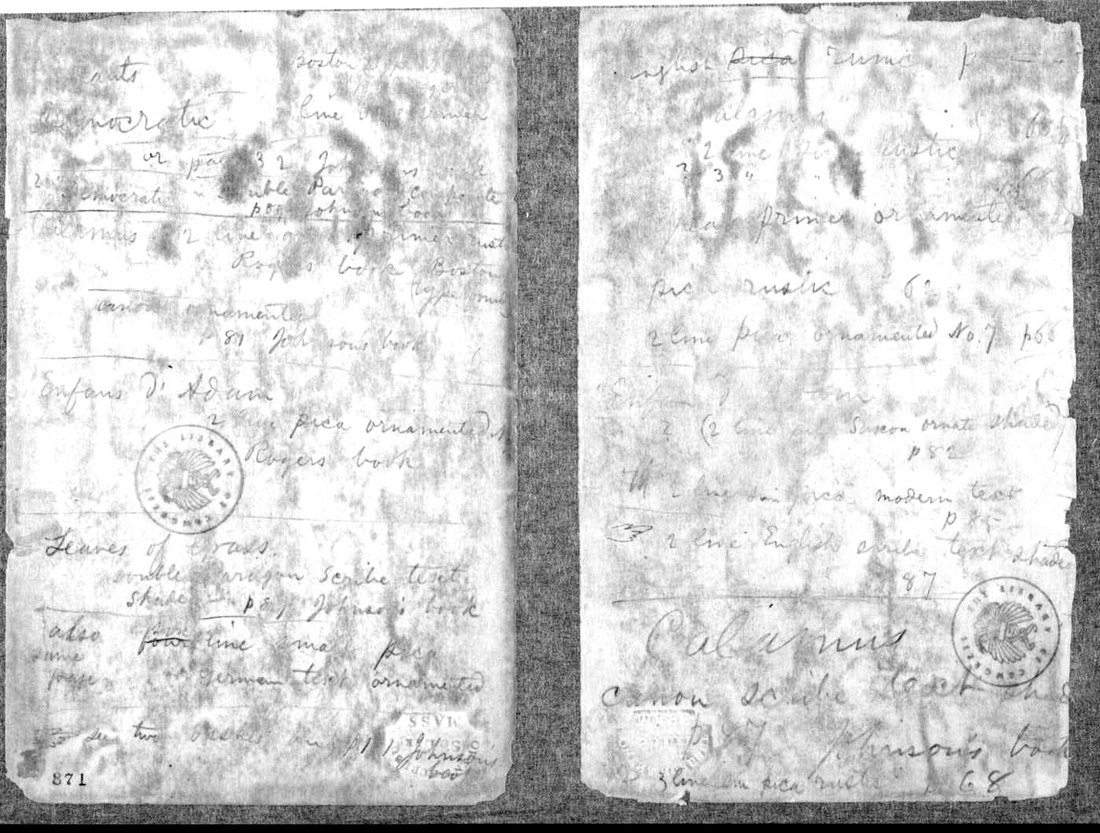
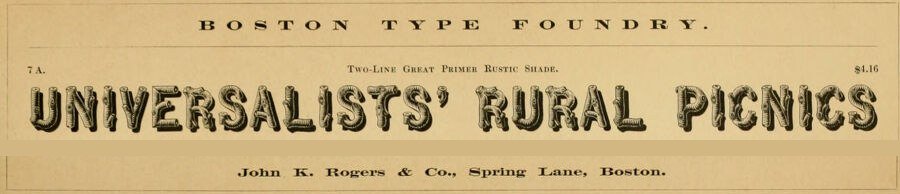
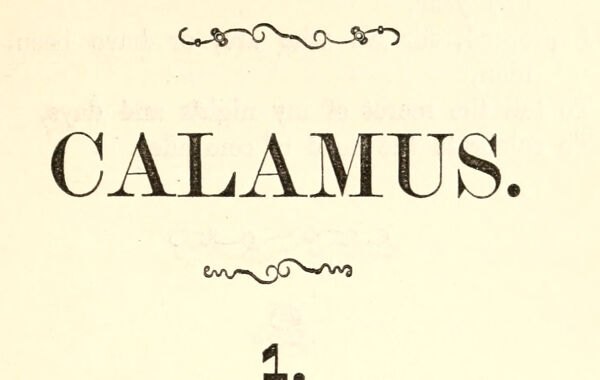
His notebook from that spring lists the typefaces he wanted, each with a page in a typefounder’s specimen book, the catalogue a foundry printed to show its faces: “canon scribe text shaded p 87 Johnson’s book”; “canon ornamented p 81 Johnson’s book”; for Calamus, “2 line great primer rustic / Rogers’s book Boston / (type foundry).” He drew pointing hands in its margins; one, at the foot of a leaf, points to “see two dashes in p 11 Johnson’s book.”5 “Johnson’s book” is L. Johnson & Co.’s specimen, from Philadelphia; “Rogers’s book” is very likely the Boston Type Foundry’s, from John K. Rogers & Co. in Spring Lane, the same lane as the stereotype foundry where he read proofs.5,6 Ed Folsom quoted the list in 2005, and Edward Grier edited the notebook in 1984, with notes on the books it names, which we have not read.1,26 What the book prints doesn’t always match the list; as Folsom put it, “some of the types were used; others were not.”1 He named a rustic face for Calamus, and a shaded scribe text, and the book sets it in plain capitals between two flourishes.7 Why, no source says.
The ornaments at the heads of poems were not drawn for him either. Folsom, with his research assistant Eric Conrad, found that “Whitman created his ornamental flourishes in this edition using at least twenty-four different border elements and six different small pica dashes,” stock pieces from Johnson’s specimen of 1859, two to twelve of them to an ornament.9 On May 10 Whitman wrote to his brother Jeff, “The typographical appearance of the book has been just as I directed it.”10
4. The stamp and the cover, 1860
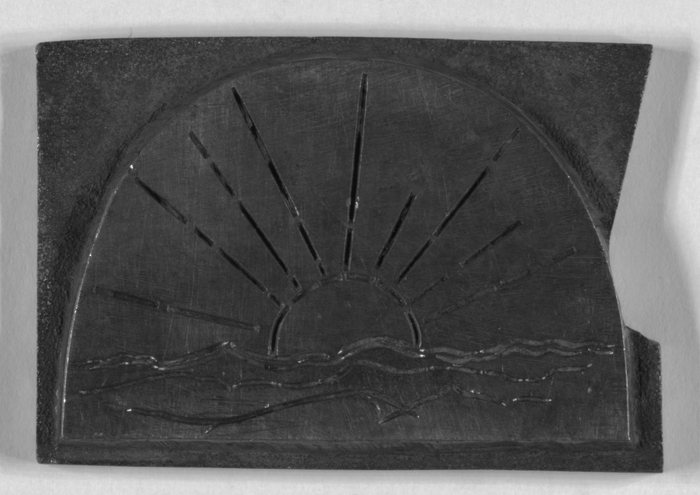
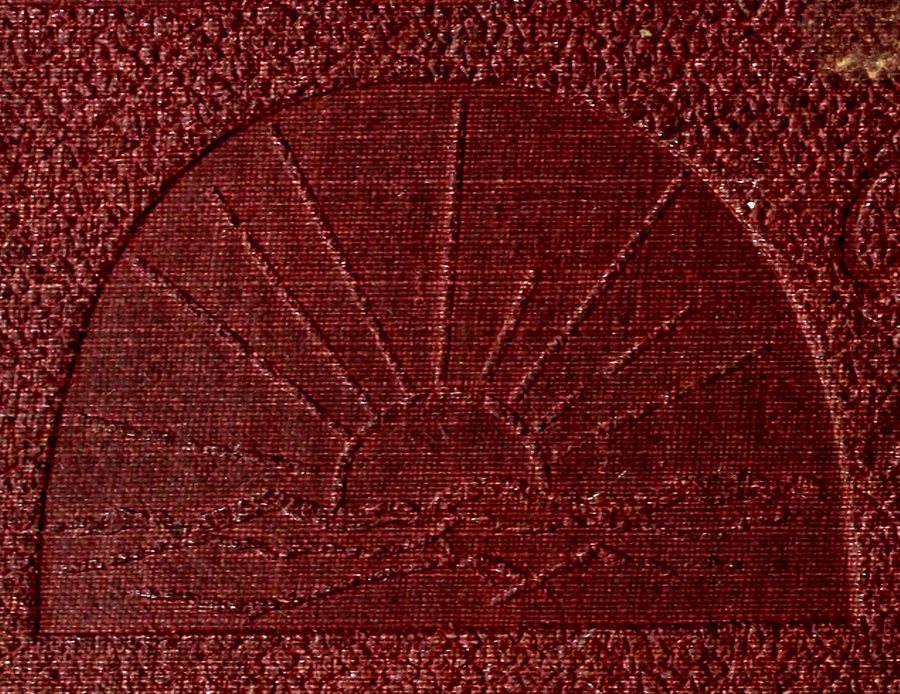
The 1860 book’s cloth carries three emblems: a globe on the front, a hand with a butterfly on the spine, and a sun over the sea on the back.1 A binder pressed them into each cover with a hot brass stamp, flat on the cloth before it was glued to the book. “The covers are made and completely finished separately from the volume,” a printers’ encyclopedia of 1871 says.13 With gold leaf laid down first, a stamp gilds; without it, it presses the cloth down and leaves a “blind” mark.13 Whitman’s flowers shows the steps side-on (Whitman’s flowers).
Stamps of the time were cut by hand, by a “block or tool cutter” working to an artist’s drawing, and copies could be made of them by electrotyping.13,14 The Library of Congress, which holds the 1860 stamps, calls the set “cast dies.”12 How these were made, we can’t tell from a photograph.
The same sun is printed inside the book, at the end of four poems, from a block of its own, set with the page’s type and moulded with it into the plate the page was printed from.7 The page and the stamp share the sun and its nine rays, line for line, but not the waves: the page has four lines of waves and a small mark under them, the stamp three. Nothing says who drew the sun, or who cut either.11 Nor does anything say who chose the emblems; Folsom reads them as Whitman’s.1
5. The plates, 1860 to 1880
A page of type, its letters standing up, is pressed into a soft mould.
Metal cast in it (stereotype), or copper grown on it (electrotype), makes a plate: the page in one thin piece.
The plate prints the page as the type did. It can be stored, sold, and printed from by whoever holds it.
Thayer and Eldridge’s plates for the 1860 book, 456 pages of them, cost “somewhere in the neighborhood of $800.”15 When the firm failed, at the end of 1860, its stock went to its assignees, and Thayer wrote to Whitman of the plates.15,17,24
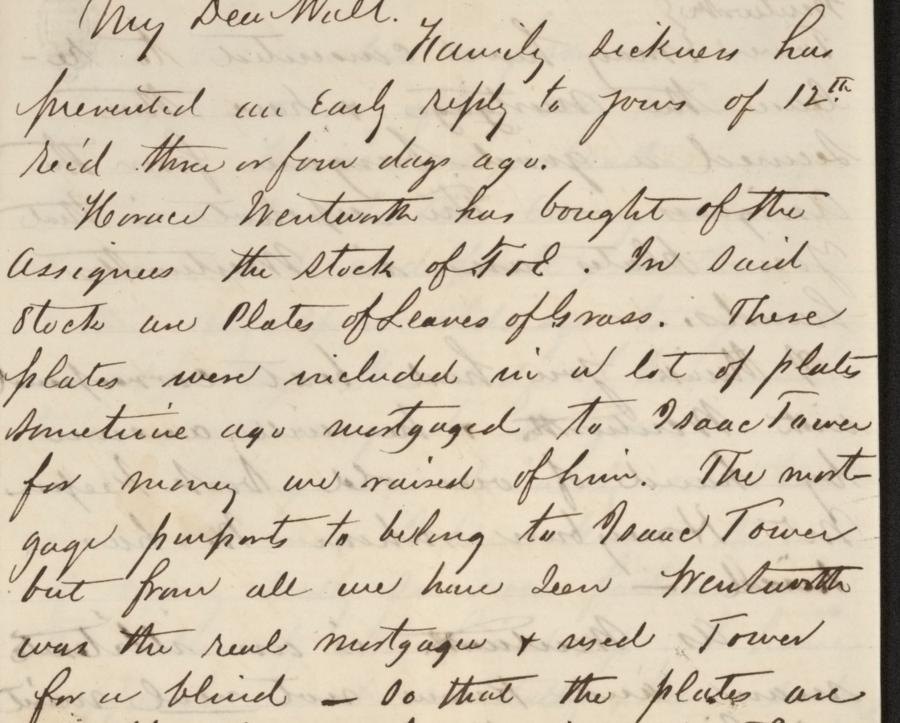
That is Thayer’s suspicion, of a man he counted his enemy. The plates were offered to Whitman in 1866 and he didn’t buy them; they were sold at auction in September 1879 for $200.15,16 Richard Worthington, a New York publisher, bought them and printed the book from them. The auctioneer had offered them to Whitman before the sale, and he had written back that they were worthless to him; he would not allow them “to be used by any one else—I being the sole owner of the copyright,” he wrote in 1880.17 Later, all the same, he took $143.50 from Worthington in royalties.17
The copy stanza drew its Whitman flowers from is very likely one of Worthington’s: it lacks the printers’ line on the back of the title page, the mark by which bibliographers have told his printings since 1922.18,27 The Bibliography of American Literature calls that test probable, not certain: Thayer and Eldridge may have dropped the line themselves before their second printing, in June 1860.28 Its reddish-brown cloth fits his too, but proves little; Thayer and Eldridge’s own came in as many as twelve colors and cloths.27 So the designs and the plates are Whitman’s; the impressions we traced are from a later printing of them, made without his leave. They are still good evidence of what the plates held.
After 1860, Whitman kept his plates. Those of 1871 were his, and so were those of 1881, which he took back in 1882 with “one hundred ($100:) dollars in cash—and the plates, sheets, dies, &c.” when his Boston publisher gave the book up.19 In Camden he stored them in his printer’s vaults, uninsured, and lent them to his publisher on a written order, “returned by March 1st.”4
6. His name in ink, 1876, and after
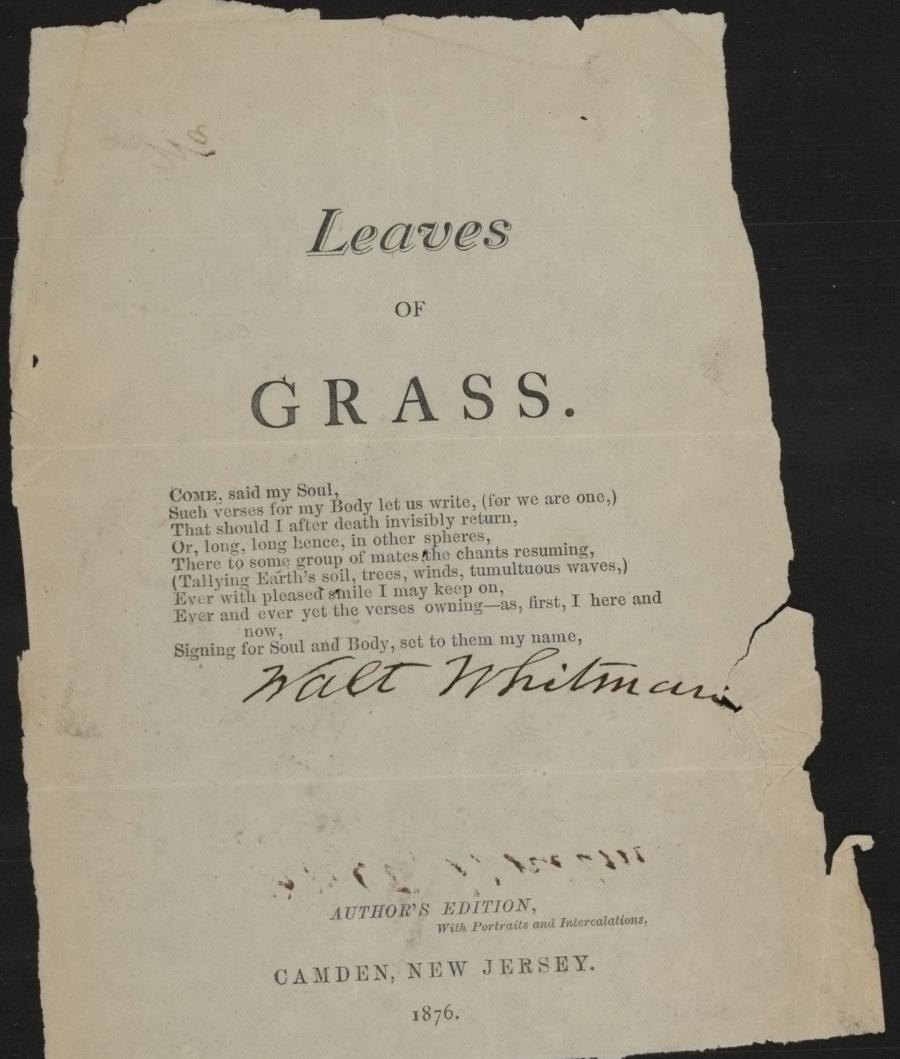
In 1876 Whitman made the book himself, in Camden: 600 copies, printed for $157, bound by James Arnold.21 Its title page carries a short poem, “Come, said my Soul,” whose last line ends “set to them my name,” with a comma, and he signed beneath it in ink. “The autograph was intended when the type was set,” Eric Conrad writes.20
From then on his part was a written specification and daily proofs. In 1881 he wrote to his Boston publisher, “The typographical show of my poems … is always in my idea in making them—I am printer enough for that,” and read proofs at the printers’ works, “five or six hours every day.”22 The cover was not his: “it is a New England notion: the Osgoods’,” he said of it in 1888.4 When the book was banned in Boston in 1882, he offered to fill the cut lines “with other matter,” so it would “at casual view all its pages, to look just the same.”22
His hands, and theirs. He dealt with the workmen, not only the firm. “I want you to reach the workmen direct,” he told Traubel in 1888, “with the man who sets the type, the man who puts it into form, the man who runs the foundry: reach them, yes, with a dollar now and then.” And of a tip for a man who pulled proofs: “Don’t give that dollar to the boss — give it to the man.”4 In 1881 he gave a reception for “my Boston friends, especially the printers &c.”: “there were three hundred came & went.”22
7. What we don’t know
Some questions the sources don’t answer. Each is set down here with what we know, what we don’t, and what would settle it.
- Why the 1855 book is so large. The paper Rome had, or his press: both are inferences from the book and the shop.2,3 A record of Rome’s stock or press would settle it.
- Who changed the line on page 49. Schmidgall, who found it, and Folsom say Whitman made the change or ordered it, and Gray reports Folsom’s; the proofs, she writes, were read by “Whitman or someone else at the print shop.”2,3,25 Nothing written at the time is known.
- Who set the 1860 type, and where. His letters put him at the foundry; the book says it was printed at Rand and Avery’s.7,8 A letter or a bill would settle it.
- Whether every 1860 ornament came from Johnson’s stock. Folsom found at least twenty-four pieces; he doesn’t name each ornament, and Johnson’s specimen of 1859 is not online.9 The specimen itself, page by page, would settle it.
- Why the page’s sun and the stamp’s differ in their waves, and how the 1860 stamps were made. No letter or record names who drew or cut them. The brass itself, examined, would be a start.11,12
- What the page’s block was made of. Wood or metal, the print can’t tell us, and the block is not known to survive.11
- Which specimen book “Rogers’s book” is. Very likely the Boston Type Foundry’s; Edward Grier’s notes on the notebook may say, and we have not read them.26
- What the copy we drew from is. Very likely Worthington’s printing from the 1860 plates, by a test that is probable, not certain.18,27,28 Joel Myerson’s descriptions of Worthington’s printings, set against this copy, would settle it; we have not read them. So would its pages laid beside a copy with the printers’ line, such as Kenneth M. Price’s, which the Walt Whitman Archive shows.7
Sources
- E. Folsom, Whitman Making Books / Books Making Whitman (2005), at the Walt Whitman Archive, as kept by the Internet Archive’s Wayback Machine. https://web.archive.org/web/20210415140402/https://whitmanarchive.org/criticism/current/anc.00150.html
- E. Folsom, “The Census of the 1855 Leaves of Grass: A Preliminary Report,” Walt Whitman Quarterly Review 24 (2006), 71–84: the sheet left with Andrew (p. 73), the book set eight pages at a time (p. 76), the line on page 49 (pp. 76–77). https://web.archive.org/web/2025/https://pubs.lib.uiowa.edu/wwqr/article/26088/galley/134456/download/
- N. Gray, “Introduction to the 1855 Leaves of Grass Variorum” (the Archive’s citation gives 2019; first published there in 2020), §§ I–IV and notes 43, 45, 51, 65; and “Binding Records” (2020), on Charles Jenkins’s statement. https://web.archive.org/web/20200813170641/https://whitmanarchive.org/published/LG/1855/variorum/intro.html · https://web.archive.org/web/2020/https://whitmanarchive.org/published/LG/1855/variorum/other/anc.02141.html
- H. Traubel, With Walt Whitman in Camden: vol. 2, p. 471 (the type he set, 1888); vol. 1, pp. 206 and 317 (the workmen, 25 May 1888 and after); vol. 2, pp. 441–42 (the plates kept and lent); vol. 3, p. 342 (the 1881 cover, 20 December 1888). The Internet Archive’s scans, vol. 1: https://archive.org/details/withwaltwhitmani01trauuoft
- W. Whitman, notebook, Boston, 1860, Library of Congress, Thomas Biggs Harned Collection (MSS45443, box 2, folder 17), leaves 871–72, the list of typefaces. https://www.loc.gov/item/mss454430068/
- Condensed Specimen Book from the Boston Type Foundry (Boston: John K. Rogers & Co., 1860), the Boston Public Library’s copy, scanned by the Internet Archive. https://archive.org/details/condensedspecime00bost
- W. Whitman, Leaves of Grass (Boston: Thayer and Eldridge, 1860–61), the Walt Whitman Archive’s transcription, from a copy with the printers’ line: “ELECTROTYPED AT THE BOSTON STEREOTYPE FOUNDRY. PRINTED BY GEORGE C. RAND & AVERY.” https://github.com/whitmanarchive/whitman-leaves_of_grass/blob/HEAD/source/tei/ppp.01500.xml · its pages as printed from the same plates, most likely by Richard Worthington, about 1880, the Lincoln Financial Foundation Collection’s copy: https://archive.org/details/leavesofgrass00inwhit
- W. Whitman to Abby H. Price, Boston, 29 March 1860, the Walt Whitman Archive’s transcription. https://github.com/whitmanarchive/whitman-correspondence/blob/dev/source/tei/pml.00011.xml
- E. Folsom, on the 1860 Leaves of Grass, Huntington Library Quarterly 73.4 (2010), 585–600, pp. 597–98. https://web.archive.org/web/2024/https://whitmanarchive.org/criticism/current/pdf/anc.02109.pdf
- W. Whitman to Thomas Jefferson Whitman, Boston, 10 May 1860, the Walt Whitman Archive’s transcription. https://github.com/whitmanarchive/whitman-correspondence/blob/dev/source/tei/wwh.00003.xml
- Whitman’s flowers (stanza.pictures, 2026), section 5, the sun on the page and on the stamp, and its sources. https://stanza.pictures/reading-room/whitmans-flowers
- The brass stamps used for the 1860 binding, Feinberg-Whitman Collection, Library of Congress, e.g. the sun (4.3 × 6.5 cm); “No known restrictions on publication.” The Library’s exhibit Revising Himself lists the set as “Assorted cast dies.” https://www.loc.gov/item/2005680549/ · https://webarchive.library.unt.edu/eot2008/20090113080952/http://www.loc.gov/exhibits/treasures/whitman-leavesofgrass.html
- J. L. Ringwalt, ed., American Encyclopaedia of Printing (Philadelphia, 1871), “How a Book is Made,” pp. ix–xv (a large house; the covers, p. xiii); stereotyping, pp. 443–44. https://archive.org/details/bub_gb_ztQoAAAAYAAJ
- J. W. Zaehnsdorf, The Art of Bookbinding (London, 1890), p. 111: “the block or tool cutter … cuts the metal accordingly.” T. MacKellar, The American Printer (Philadelphia, 1871), p. 34: electrotypes as “duplicates of cuts, jobs, binders’ stamps.” https://archive.org/details/artofbookbinding00zaehrich · https://archive.org/details/americanprinter00mackgoog
- H. Wentworth to W. Whitman, 16 November 1866, the Walt Whitman Archive’s transcription; and D. Donlon, “Thayer and Eldridge,” Walt Whitman: An Encyclopedia. https://github.com/whitmanarchive/whitman-correspondence/blob/dev/source/tei/yal.00101.xml · http://web.archive.org/web/20260218130428/https://whitmanarchive.org/item/encyclopedia_entry57
- W. Whitman to John Burroughs, 7 December 1880, quoting R. M. Bucke: the plates sold “in Sept: 79 for $200.” https://github.com/whitmanarchive/whitman-correspondence/blob/dev/source/tei/uva.00385.xml
- W. Whitman to Richard Watson Gilder, 26 November 1880, the Walt Whitman Archive’s transcription, with its note on the royalties from Worthington. https://github.com/whitmanarchive/whitman-correspondence/blob/dev/source/tei/hyb.00015.xml
- DeGolyer Library, Southern Methodist University: Worthington’s reprint, “without the printer’s name (George C. Rand & Avery) on verso of title page,” in “reddish-brown cloth.” https://degolyer.omeka.net/items/show/802
- W. Whitman, receipt to James R. Osgood & Co., 23 May 1882, the Walt Whitman Archive’s transcription. https://github.com/whitmanarchive/whitman-correspondence/blob/dev/source/tei/loc.00533.xml
- E. Conrad, Walt Whitman Quarterly Review 32.4 (2015), 187–214, pp. 202–3. https://pubs.lib.uiowa.edu/wwqr/article/id/26243/
- W. Whitman’s letters on the 1876 printing and binding, the Walt Whitman Archive’s transcriptions: loc.01723 (“600 copies, 348 pages, will come to $157”) and loc.01602 (James Arnold, 21 August 1876). https://github.com/whitmanarchive/whitman-correspondence
- W. Whitman to James R. Osgood, 7 June 1881 (yal.00109); 27 August 1881 (mhs.00008); to Ruth Stafford, 25 October 1881 (loc.04257); to Osgood, 23 March 1882 (tex.00440); the Walt Whitman Archive’s transcriptions. https://github.com/whitmanarchive/whitman-correspondence
- Proof of the title page of the 1876 Author’s Edition, signed, Library of Congress, Manuscript Division, Charles E. Feinberg Collection, “Leaves of Grass; 1876 edition; Proofs,” image 5, with the Library’s card. https://www.loc.gov/item/mss1863000490/
- W. W. Thayer to W. Whitman, 19 April 1861, Library of Congress, Manuscript Division, Charles E. Feinberg Collection. https://www.loc.gov/item/mss1863000388/
- G. Schmidgall, “1855: A Stop-Press Revision,” Walt Whitman Quarterly Review 18 (2000): the Berkeley and New York Public Library copies compared; “Clearly, Whitman stopped the press and either ordered the change or made it himself.” https://pubs.lib.uiowa.edu/wwqr/article/26587/galley/134955/view/
- The Walt Whitman Archive’s description of the notebook (loc.ead01_loc.04605), as kept by the Internet Archive’s Wayback Machine: “Edward Grier provides information about the specific books that Whitman mentions, noting similarities between them and Leaves” (E. F. Grier, ed., Notebooks and Unpublished Prose Manuscripts, New York, 1984, 1:419–21; not read). https://web.archive.org/web/20241104204332/https://whitmanarchive.org/item/loc.ead01_loc.04605
- C. J. Wells and A. F. Goldsmith, A Concise Bibliography of the Works of Walt Whitman (Boston, 1922), pp. 7–10: “all the Worthington reprints lack the words: ‘Electrotyped at the Boston Stereotype Foundry. Printed by George C. Rand and Avery,’ on the verso of the title-page”; of Thayer and Eldridge’s bindings, “As many as twelve varieties of color, cloth, and embossing have been noted.” The University of California’s copy, as text. https://distantreader.org/stacks/trust/uc2/uc2_ark+=13960=t70v8b447.txt
- M. Winship, Bibliography of American Literature, vol. 9 (1991), no. 21397, as quoted in Freeman’s sale of books and manuscripts, lot 80, as kept by the Internet Archive’s Wayback Machine: “it seems probable that all copies lacking the printer’s and stereotyper’s imprints on the copyright page were published by Worthington after 1879, but it is not impossible that the imprints were removed by Thayer and Eldridge before the second printing of June, 1860.” https://web.archive.org/web/20240227011920/https://www.freemansauction.com/auctions/books-and-manuscripts-1714/lot/80
stanza · The reading room · November 2026